

St. Patrick, St. Joseph, St. Cuthbert, and a Poem

Here are drawings I have made of three saints commeorated this week: St. Patrick (3/17), St. Joseph (3/19), and St. Cuthbert of Lindisfarne (3/20). Click on the pictures below for prints, digital downloads, or full descriptions.

I drew St. Patrick in the style of 6-9th century Northumbro-Irish art, surrounded by decorative knotwork, lacertine animals, geometric patterns and rune-like lettering. He wears a mitre and holds a cloverleaf representing the Holy Trinity. The lettering reads Sanctus Patricius (St. Patrick).

This depicts the second dream of St. Joseph, in which an angel (traditionally identified as St. Gabriel) warns him to flee into Egypt with the Blessed Virgin Mary and the Christ Child. In this work, I especially imitated the style of Tsukioka Yoshitoshi, a late ukiyo-e master. I referenced his series of woodblock prints 100 Aspects of the Moon for many parts of my drawing.
St. Gabriel holds a fan containing a vision of the Flight into Egypt and the Miracle of the Cherry Tree. I attempted to convey a sense of otherworldly urgency by having the angel’s robes and hair blown by a strong wind that affects nothing else in the picture. St. Joseph sleeps in the stable of Bethlehem, next to the gifts of the Magi (in antique Chinese vessels).

St. Cuthbert of Lindisfarne was a missionary, abbot, hermit and bishop of the seventh century.
Formed in the Celtic monastic tradition at the Scottish Abbey of Melrose, St. Cuthbert accepted the decision of the Synod of Whitby to adopt Roman practices regarding the shape of monastic tonsure and the paschal computus. Shortly thereafter, he entered the Abbey of Lindisfarne, located on an island off the Northumbrian coast, where he became prior and later abbot. Renowned for his asceticism and miracle-working, he would spend entire nights submerged to his neck in the chill surf, reciting psalms. Otters would dry and warm his exhausted body on the beach in the morning. Other beasts and birds, such as the local eider ducks, were said to obey his words. For years, he lived as a hermit on a tiny island near Lindisfarne, before being recalled to become bishop of the diocese.
I depicted St. Cuthbert early in his life, about the time that he first came to Lindisfarne. He wears the Roman (Petrine) tonsure, although his Celtic (Johannine) tonsure has not yet fully grown out; that is why the hair on the front half of his head is shorter. The pectoral cross and ring are based on actual relics of the saint, although simplified somewhat due to the small scale of the drawing.
The ornamental frame and haloes are based on Northumbro-Irish art from the era of St. Cuthbert, most especially the Lindisfarne Gospels that were dedicated to him. The knots and spirals are interwoven with thistles, two eider ducks and an otter. Here I attempted to draw upon the ornamental art of the early medieval manuscripts, while using more natural forms for people, plants, birds and beasts.
Here is a poem from my collection, The Gustable God:
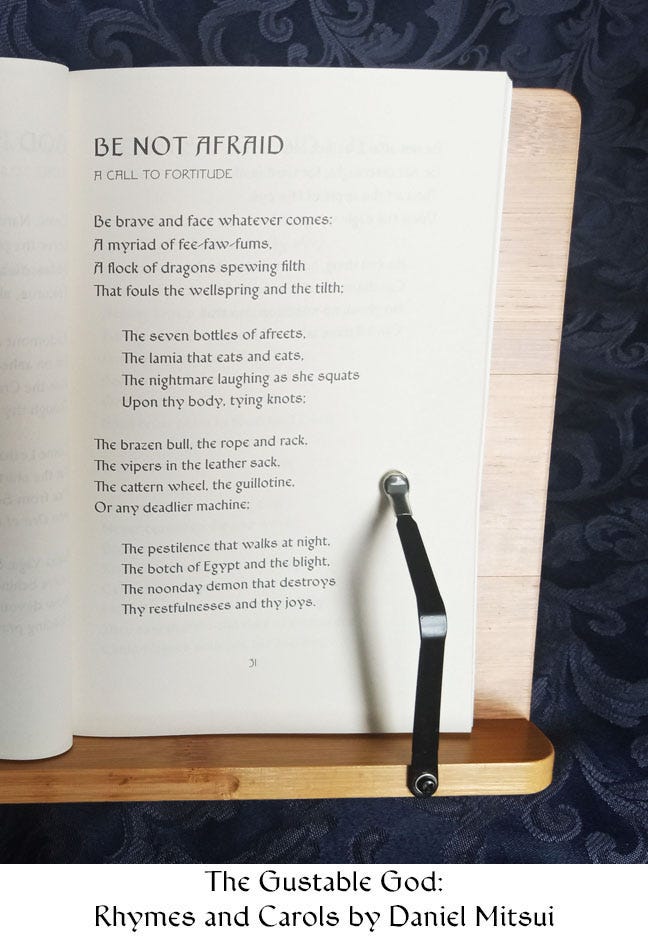
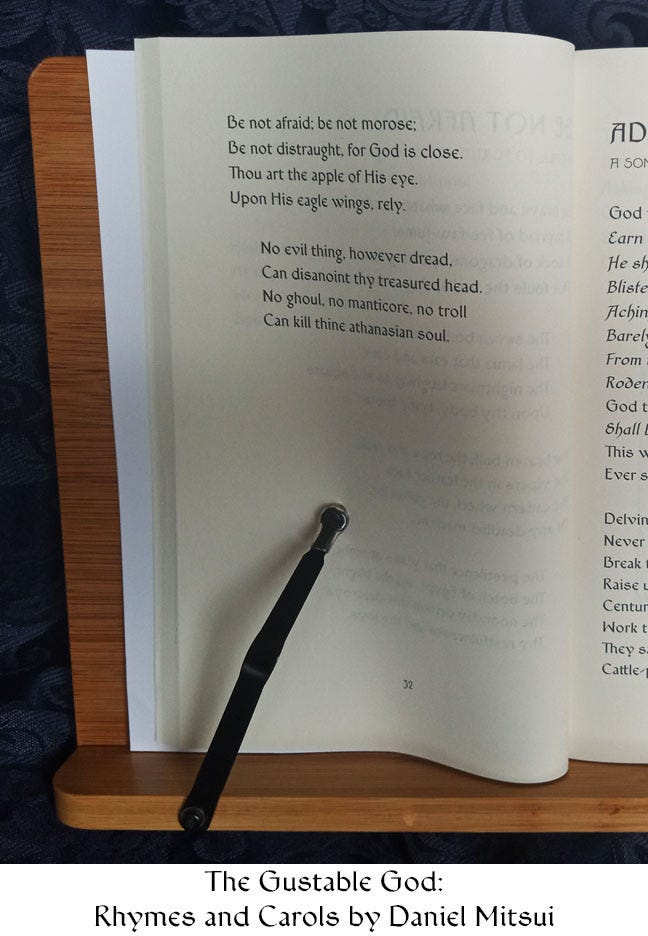
This book is available at my webite here, or through Amazon. It includes forty religious poems that I wrote, illustrated with my own drawings and set in my own typefaces.